


The Dermatologist's Guide to Calming Reactive Skin: Ingredients That Actually Work
Reactive skin is one of the most common concerns Dr Zamani sees in her Chelsea clinic, and one of the most persistently misunderstood. Patients arrive having cycled through soothing products, stripped their routines back to nothing, or avoided all active ingredients for months. Without realising it, each of these responses can make the situation worse: stripping the skin removes the lipids it needs to protect itself, and avoiding all actives means the barrier never gets the targeted support it needs to actually repair. What is rarely addressed is what is actually happening at a structural level: a skin barrier that is signalling distress, and a skincare ritual that has yet to answer it.
Calming reactive skin is not about eliminating every possible irritant from your life. It is about understanding what the skin needs to rebuild its own resilience, and choosing ingredients that support that process with clinical precision.
What Makes Skin Reactive in the First Place?
Reactive skin is not a skin type. It is a state. More precisely, it is the result of a compromised stratum corneum, the outermost layer of the skin that regulates hydration, defends against environmental aggressors, and maintains the microbiome balance that keeps inflammation in check.
When this barrier is disrupted, the consequences are both immediate and cumulative. Transepidermal water loss (TEWL) increases, moisture escapes, and external irritants penetrate more easily. The skin responds with inflammation, sensory discomfort, and heightened reactivity to products it previously tolerated without issue. This is not the skin failing; it is the skin communicating. The skin's inflammatory response is a signal, not a character flaw. The goal is not to silence it, but to address its underlying cause.
Common drivers of barrier disruption include:
-
Over-exfoliation: the misuse of high-percentage acids, physical scrubs, or enzyme treatments that strip essential lipids from the skin's surface
-
Harsh surfactants: traditional foaming cleansers that disrupt the lipid matrix with every wash
-
Environmental stressors: UV exposure, pollution, changes in weather, and seasonal temperature fluctuations, all of which destabilise the skin's ability to maintain its natural balance
-
Hormonal fluctuation and chronic stress: both directly compromise barrier function and amplify inflammatory responses
In many cases, the products people reach for to manage reactivity are precisely those making it worse.
The Ingredients That Actually Work
Calming reactive skin requires a targeted approach: specific actives, delivered at therapeutic concentrations, in formulations that support rather than compromise barrier function. The following ingredients have the strongest clinical evidence for soothing and repairing reactive, sensitive skin.
Ceramides
Ceramides are the structural lipids that make up the majority of the skin's intercellular matrix, the mortar between skin cells that keeps the barrier sealed. Think of them as the glue that holds the skin's protective layer together: Without adequate ceramide levels, microscopic gaps form, moisture escapes and irritants penetrate more easily. When ceramide levels are depleted through age, environmental damage, or over-exfoliation, reactivity follows.
Topically applied ceramides replenish this matrix directly, integrating into the stratum corneum to restore the barrier's sealing function and reduce TEWL. Ceramide NP is one of the most clinically evidenced ceramide variants for barrier repair, and it appears across two key MZ SKIN formulations.
For the delicate skin around the eye area, where the barrier is thinnest and reactivity often presents first, the Soothe & Smooth Hyaluronic Brightening Eye Complex delivers Ceramide NP alongside hydrolysed hyaluronic acid and a collagen-stimulating tri-peptide, restoring moisture and resilience to a zone that conventional moisturisers frequently overlook. For the face and broader barrier recovery, the Hydra-Boost Ampoules provide a five-day intensive reset, delivering ceramides across multiple layers of the stratum corneum.
Results are progressive but measurable, and both formulations are suitable for even the most sensitised skin.
Bisabolol
Bisabolol is a naturally derived compound from the German chamomile plant, with well-documented anti-inflammatory and skin-calming properties. It works by inhibiting specific inflammatory pathways within the skin, reducing redness and sensory irritation at the point of contact. It is also a penetration enhancer, which means it supports the delivery of other actives into the deeper layers where structural repair happens.
Because bisabolol works on contact and enhances the delivery of everything around it, it is an ideal addition to a cleanser: the one step where the skin is most exposed, the barrier is at its most vulnerable, and the products that follow will be absorbed most readily.
The MZ SKIN Calming Cream Cleanser is formulated around Bisabolol alongside omega-rich Sweet Almond and Jojoba Oils, Vitamin E, and a Prebiotic Complex derived from chicory root. Rather than simply removing impurities, it actively replenishes the lipids and microbial balance the barrier depends on at the very moment of cleansing. The results from independent user trials reflect this: 90% of users agreed their complexion looked calmer with redness visibly reduced within 15 minutes of first use, and 93% noticed a significant reduction in redness after four weeks of consistent use. It is also fragrance-free and dermatologically tested, making it appropriate for even the most compromised reactive skin.
Bisabolol features in the Hydra-Boost Ampoules for the same reason: delivering its calming action at the point of highest skin vulnerability, immediately after cleansing, when the barrier is most receptive to repair.
Prebiotic Complexes (Inulin / Chicory Root)
The skin microbiome, the community of bacteria, fungi, and other microorganisms that live on the skin's surface, plays a central role in immune regulation and barrier function. A disrupted microbiome contributes directly to chronic, low-grade inflammation. Prebiotic actives derived from chicory root (inulin) selectively nourish the beneficial bacteria that maintain this balance, without disrupting the broader microbial community.
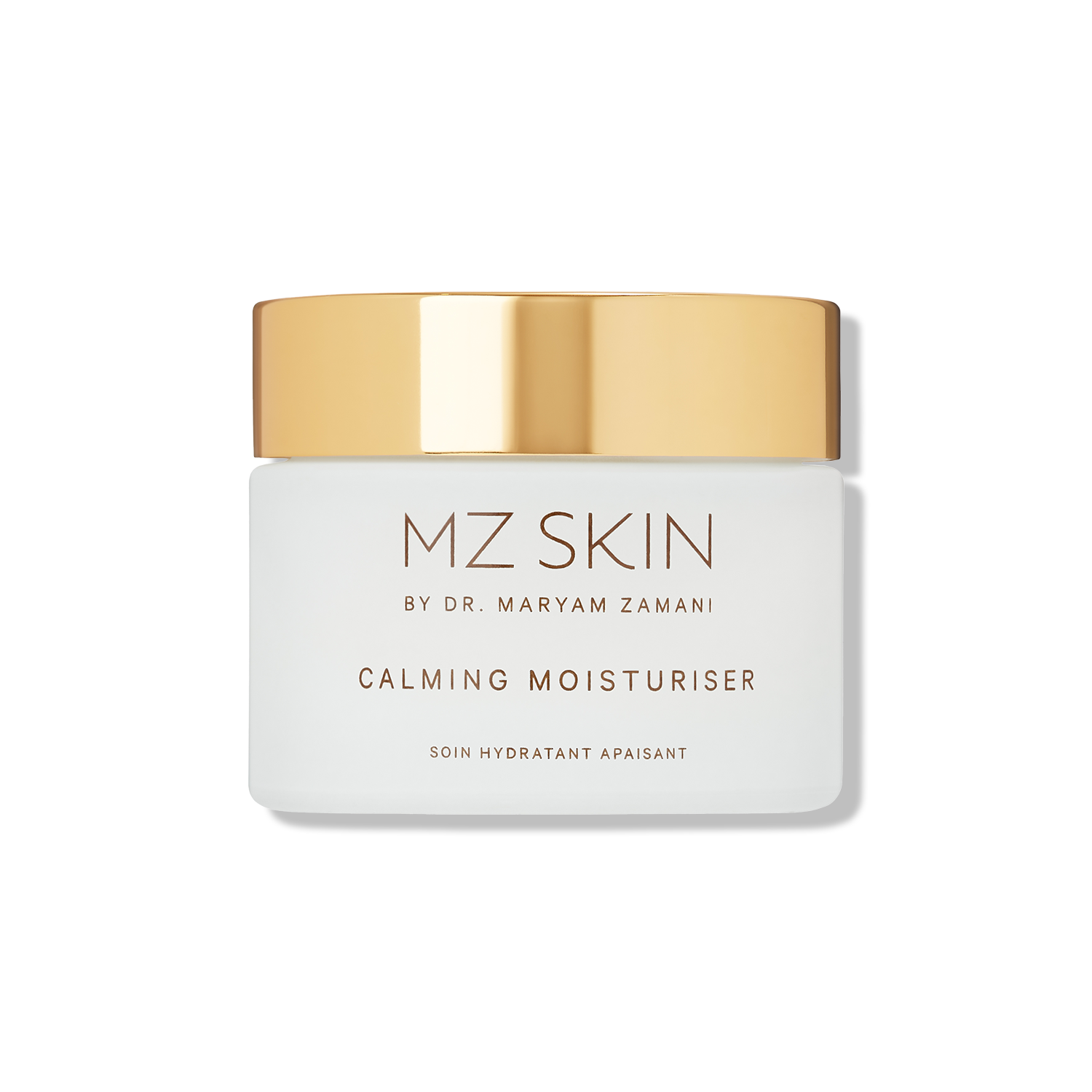
The Calming Moisturiser is formulated around a Prebiotic Complex of this kind, combining it with Red Sage Root, Centella Asiatica, and Squalane to nourish and protect the skin's natural defences whilst delivering lasting hydration. Rather than simply moisturising the surface, it actively supports the microbiome balance the barrier depends on. In independent user trials, 93% of users agreed skin felt comfortable, soothed, and instantly calmed, and 97% agreed skin felt nourished and protected.
Hyaluronic Acid (Sodium Hyaluronate)
Dehydration and reactivity are closely linked. When the skin lacks adequate hydration, the barrier's ability to regulate its own responses is compromised, and even mild irritants trigger disproportionate reactions. Hyaluronic acid, and its smaller-molecule form sodium hyaluronate, address this by drawing moisture into the skin and retaining it there.
The mechanism matters here, and not all hyaluronic acid formulations work in the same way. The Bio-Placenta Hyaluronic Acid Serum uses a 4D hyaluronic acid complex, four molecular weights of hyaluronic acid that penetrate multiple layers of the skin simultaneously, providing both an immediate surge of hydration and sustained replenishment over time. In independent clinical trials, it was proven to improve skin hydration by 56.5% after just 30 minutes, with 77% of users agreeing their skin felt more hydrated after one month of consistent use. It also contains Bio-Placenta, a lab-engineered vegan active that replicates the growth factors found in human placenta: Epidermal Growth Factor (EGF) stimulates fibroblasts to produce both hyaluronic acid and collagen, while Acidic Fibroblast Growth Factor supports dermal repair and overall moisture retention. The result is a serum that addresses dehydration not just at the surface but at the structural level, making it particularly valuable for reactive skin where compromised barrier function and moisture loss are compounding one another.
For sealing that hydration in, the MZ SKIN Rich Moisturiser uses Encapsulated Hyaluronic Acid delivered within a protective carrier that penetrates into the epidermis to provide sustained hydration over time, rather than simply at the moment of application.
Squalane
Squalane is a plant-derived lipid that closely mirrors the sebum the skin produces naturally. It is non-comedogenic, deeply emollient, and exceptionally well-tolerated by reactive skin types. Its primary function in a calming routine is to reinforce the skin's lipid barrier and prevent moisture loss, without the occlusive heaviness that can trigger sensitivity in some formulations. For those whose reactive skin still requires daily protection and age defence, the Hydrate & Nourish Age Defence Retinol Day Moisturiser SPF30 combines squalane with retinol, ceramides, hyaluronic acid, and broad-spectrum SPF 30 in a single daily step: reinforcing the lipid barrier whilst simultaneously addressing texture, firmness, and UV-induced barrier damage. For more acute barrier distress, the Hydra-Boost Ampoules deliver squalane as part of their intensive five-day reset, working in concert with ceramides and bisabolol to restore lipid integrity at a deeper level.
Myrothamnus Flabellifolia (The Resurrection Plant)
One of the more unusual actives in the MZ SKIN formulation library, Myrothamnus flabellifolia (known as the resurrection plant) is capable of surviving complete desiccation and returning to full biological function when rehydrated. Its extract has been shown to protect skin cells from oxidative stress and support cellular repair under conditions of environmental challenge. In the Hydra-Boost Ampoules, it acts in concert with ceramides and squalane to restore vitality to a skin barrier under stress.
The Order of Operations Matters
One of the most consistent clinical observations in Dr Zamani's practice is this: Reactive skin does not respond well to corrective actives when the barrier has not first been stabilised. Introducing retinoids, high-strength acids, or exfoliants to a compromised barrier will accelerate inflammation rather than deliver results. A minimum of four to six weeks of barrier-focused care is recommended before reintroducing performance actives.
The MZ SKIN Reveal, Enhance, Protect philosophy is built around this sequencing. Cleansing must support rather than strip. Active ingredients must be delivered within formulations that reinforce the barrier simultaneously. And protection, through a rich moisturiser and daily SPF, must seal in what has been built.
Reveal: The Calming Cream Cleanser purifies without stripping, using Sweet Almond and Jojoba Oils to deliver the essential fatty acids the barrier depends on, a Prebiotic Complex derived from chicory root to support the skin microbiome, and bisabolol to calm redness at the moment of contact.
Enhance: The Calming Rescue Serum delivers a targeted prebiotic and antioxidant formula built around a Glucoside Complex that visibly minimises redness and rebalances the complexion over time. For skin in acute distress, the Hydra-Boost Ampoules provide a five-day intensive reset, replenishing ceramides, squalane, and bisabolol across multiple layers of the stratum corneum.
Protect: The Calming Moisturiser seals the routine, combining a Prebiotic Complex, Red Sage Root, Centella Asiatica, and Squalane to nourish and protect the barrier while keeping the skin calm and balanced. The Expert UV Protector SPF50 completes the morning routine with broad-spectrum UVA and UVB defence, because UV is one of the primary drivers of barrier disruption and daily sun protection is non-negotiable.
What to Expect During Barrier Recovery
Barrier repair is not instantaneous, and should not be treated as such. The skin renews itself over a cycle of approximately 28 days, extending to 45 to 60 days by the 40s. Meaningful improvement in reactivity and redness typically emerges within four to six weeks of consistent barrier-focused care.
The transition period may involve some surface adjustment. This is a physiological response to the skin recalibrating, not a reason to abandon the process.
Reactive skin is not a permanent state. It is the skin communicating that its first line of defence needs support. When that support is given consistently, with the right ingredients in the right sequence, the barrier rebuilds. Reactivity decreases. Resilience returns.
Frequently Asked Questions
What ingredients are best for reactive skin?
Ceramides, bisabolol, prebiotic complexes, hyaluronic acid, and squalane are among the most clinically evidenced ingredients for calming reactive skin. They work to repair the barrier, reduce inflammation, rebalance the microbiome, and restore hydration, addressing the root cause of sensitivity rather than simply suppressing its symptoms.
Can reactive skin use active ingredients like retinol or acids?
Not until the barrier has been stabilised. Introducing retinoids or exfoliating acids to a compromised barrier accelerates irritation rather than delivering results. A minimum of four to six weeks of barrier-focused care is recommended before reintroducing actives.
How long does it take for reactive skin to calm down?
Most people begin to notice a meaningful reduction in sensitivity and redness within four to six weeks of consistent barrier-focused care. Full structural recovery may take longer, depending on the degree of damage and consistency of the routine.
Is reactive skin the same as sensitive skin?
Not exactly. Sensitivity is a symptom. A compromised skin barrier is frequently its cause. When the barrier is intact, the skin can regulate its response to external stressors. When it is disrupted, even mild products or environmental triggers can provoke a disproportionate reaction.
What skincare routine is best for reactive skin?
A barrier-repair routine built around a gentle, lipid-rich cleanser, a targeted soothing serum, and a ceramide-based moisturiser, applied consistently morning and evening, with daily SPF. Avoid foaming cleansers, high-percentage exfoliants, and introducing too many new actives simultaneously.